
Budgeting Custom Fragrance Development for a Body Care Line
The money a brand spends on custom fragrance development is spent before a single saleable unit exists, which is exactly why it gets under-budgeted. Briefing, sampling rounds, application testing, stability work, documentation and the commercial terms around ownership each carry a cost, and only some of them appear on a supplier's price list. Treat them as separate lines and the development phase stops being a surprise; treat the supplier's headline figure as the whole cost and the first invoice after sampling will be the surprise instead.
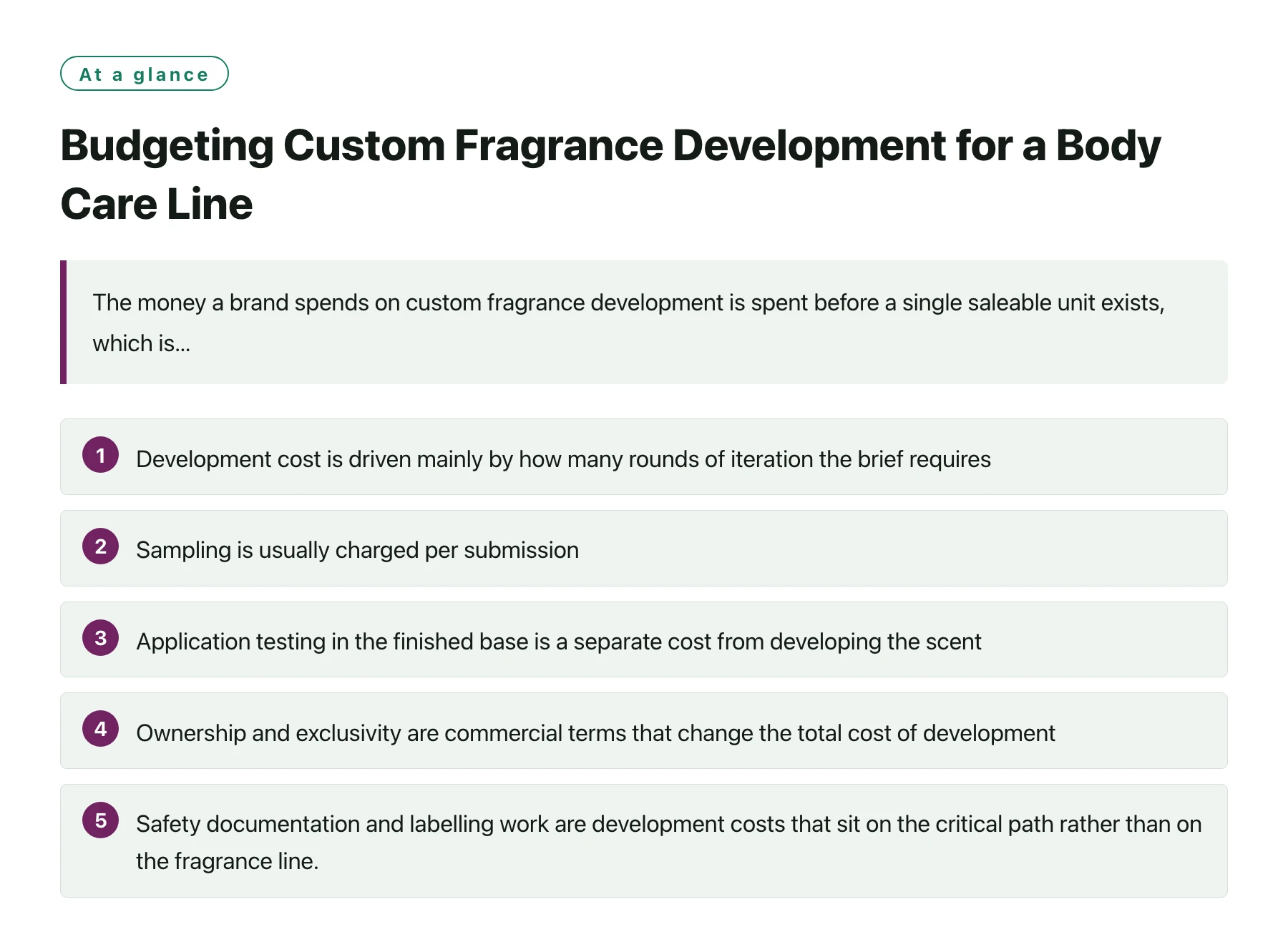
Key takeawaysDevelopment cost is driven mainly by how many rounds of iteration the brief requires, not by how complex the fragrance sounds. · Sampling is usually charged per submission, and the fee is sometimes credited against a later production order, so ask what happens if the project stops. · Application testing in the finished base is a separate cost from developing the scent, and body care makes it unavoidable. · Ownership and exclusivity are commercial terms that change the total cost of development, because a transferred formula is not the same product as a licensed one. · Safety documentation and labelling work are development costs that sit on the critical path rather than on the fragrance line.
Founders usually budget for the first order and discover that development sits in front of it. That phase has its own cost structure, and the structure is different: it scales with iterations rather than with units, so it does not become cheaper when the production run grows.
This article sets out the lines a body care brand should expect and, for each one, the decision that keeps it proportionate. It is written for the person who has to explain the number to a finance partner.
Why development costs are invisible in a unit price
A unit price is a production figure. It covers materials, filling, packaging and the margin on a run, and it assumes the formula already exists. Development is the work that creates the thing being priced, so it appears on a separate invoice, if it is itemised at all.
This separation is normal in the industry and frequently misunderstood by buyers in their first project, who compare two quotes on unit cost while one of them has quietly excluded development work. The fix is not to demand a single blended figure; it is to keep the two phases on separate budgets so that neither can hide inside the other.
None of this implies that a supplier is concealing anything. A house such as Xuelei Perfume that develops fragrance and then produces it under the same organisation can tell you upfront which development costs disappear once production begins, which is one of the most useful pieces of information a buyer can hold while writing a development budget.
Development cost lines and what triggers them
| Cost line | What triggers it | How to keep it proportionate |
|---|---|---|
| Briefing and direction work | A brief that changes direction between rounds | Settle format, base, market and dosage target before sampling |
| Sampling submissions | Each round of modifications, plus shipping and any dossiers | Consolidate feedback into one written set of changes per round |
| Application testing in the base | A body care format that must be tested inside the finished product | Test in the real base from the first round rather than the third |
| Compatibility and stability work | Shelf-life claims and packaging interactions | Fix the pack and the claimed shelf life early, then test once |
| Safety documentation and labelling | The destination market and the materials in the formula | Confirm the market before the formula is frozen |
| Ownership and exclusivity terms | Whether the formula transfers to you or stays with the developer | Negotiate before development starts, while the work is still optional |
The last line is the one buyers most often leave out of the budget and later regret, because it is a commercial negotiation rather than a technical one.
Budgeting the phase in five steps
- Separate development from productionGive the development phase its own budget line and its own approval decision, so a change of direction does not silently consume the production allowance.
- Count rounds, not formulasAssume two or three fragrance rounds plus at least one round inside the finished base. Each round has a cost and a calendar consequence.
- Ask what the sampling fee includesA submission fee may cover a formula, a sample in the base, or only a concentrate. Ask before the first round rather than on the invoice.
- Price the testing separatelyCompatibility, stability and any external laboratory work are distinct from development. Get them quoted as their own lines.
- Settle ownership before the first briefDecide whether the formula transfers, whether the scent is exclusive, and what happens if you take it to another producer. Terms are easier to agree when nothing depends on them yet.
How to read the numbers you are sent
Development invoices rarely arrive in the format a buyer would choose. A single figure may cover briefing, several rounds of sampling and a dossier, while the testing that follows is quoted separately by a laboratory. Splitting the invoice into those parts is a reasonable request, and it is easier to make before the work starts than after the first round is complete.
Buyers who want to go further can study reading a perfume price breakdown before the briefing meeting, because knowing which lines normally exist makes the discussion far shorter and the negotiation much less speculative.
The ownership question belongs in the budget
A fragrance formula is a commercial asset, and rights in it are a matter of agreement rather than of default. Organisations such as the World Intellectual Property Organization publish guidance on how intellectual property is protected across borders, precisely because arrangements that look obvious in one jurisdiction behave differently in another [1].
In practice, three arrangements cover most fragrance projects: the formula stays with the developer and you hold a licence to use it, the formula transfers to you outright, or the work is commissioned as development for hire with defined limits on how the same scent may be reused. Each has a different price, and the difference is often smaller than the cost of discovering the arrangement by accident.
Testing is where budgets quietly expand
Application testing, compatibility checks and stability work rarely arrive as a single figure. Laboratory testing services price them individually, and the scope depends on the product and the destination market [2]. A body care brand that expects to sell across several climates should plan for a wider test programme than one serving a single country.
Ask for the development element separately
When a supplier offers bespoke fragrance development and production as a single programme, ask for the development element to be shown separately from the production element. That request is normal and it makes the second quotation comparable with the first.
Write the development budget with a contingency for one extra round. Almost every body care project needs one, and a budget that assumes the first sample is the last is not optimistic, it is incomplete.
Sources
- WIPO — World Intellectual Property Organization —— The UN agency for intellectual property; resources on industrial design and patent protection relevant to product and packaging design.
- SGS: Cosmetics, Personal Care & Household Testing —— Testing, inspection and certification services for cosmetics and personal care, including microbiological, stability and safety testing aligned with cosmetics GMP.
Frequently asked questions
Is custom fragrance development always more expensive than adapting a stock scent?
Usually yes, because development pays for iterations. Adapting an existing compound to your base can be considerably cheaper and faster, and it is often the right first step for a body care line that needs to reach the market quickly.
What does a sampling round typically include?
It varies. Some suppliers charge per submission of concentrate; others include an application sample in the base at an additional cost. Ask for the definition in writing before the round begins.
Should I pay for stability testing before I have a production order?
It is usually cheaper to test once, early, than to discover a problem after a bulk run. The scope should match your shelf-life claim and your destination markets rather than being as broad as possible.
Who owns a custom fragrance formula?
Whoever the agreement says. Ownership can stay with the developer with a licence to you, transfer to you, or sit with a defined split. Decide before development starts, because the terms affect both the price and what you can do later.
How do I compare a development quote with a production quote?
Keep them on separate lines and compare them separately. A single blended figure hides which part of the project is expensive, which is precisely the information you need to negotiate.
Ready to talk strategy with a senior partner?
Discreet, no-obligation discovery call. We listen first.