
Two Weeks at a Time: Planning Around Difficulty Adjustments
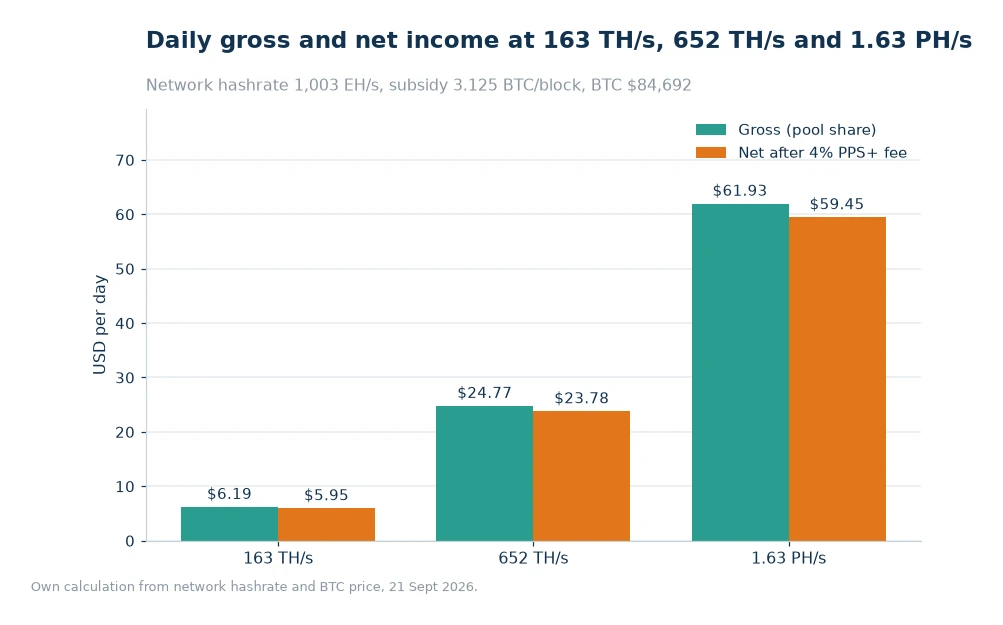
Bitcoin's difficulty moves roughly every two weeks, and each move rewrites the value of every terahash in the room. The current reading is 132.76 T with an estimated change of -2.12% at the next adjustment, which would lift output per unit of hash by about 2.17%. At 163 TH/s that turns 7.312e-05 BTC a day, or $6.19 gross and $5.95 net after the listed 4% on the block-reward component, into roughly $6.32 gross.

Key takeaways
- 163 TH/s earns 7.312e-05 BTC a day, $6.19 gross and $5.95 net at the current difficulty and price.
- The estimated -2.12% adjustment raises revenue per terahash by about 2.17%, the reciprocal of 0.9788.
- 652 TH/s earns 0.00029252 BTC and $24.77 gross; 1.63 PH/s earns 0.00073123 BTC and $61.93 gross.
- Difficulty is quoted in trillions, so a change of 2.8 T is small in percentage terms and large in dollars across a fleet.
The dial that moves every 2,016 blocks
Difficulty is the network's way of holding block intervals near ten minutes as total hashrate changes. Every 2,016 blocks, roughly fourteen days, the protocol compares the time those blocks actually took with the time they should have taken and adjusts the target accordingly. More hash than expected means a harder target; less hash means an easier one.
For a miner, the adjustment is a change in the price of a share. A harder target means the same machine finds fewer shares for the same electricity, so revenue per terahash falls. An easier target does the reverse. The machine has not changed, the pool has not changed and the listed fee has not changed; only the exchange rate between joules and coins has moved.
What a two percent move is worth
Two percent sounds like rounding. On a single machine it nearly is: at 163 TH/s, $6.19 gross becomes about $6.32, an extra thirteen cents a day. On a fleet it compounds into something worth scheduling around, and on a purchase decision it can separate two candidates that looked identical last week.
The arithmetic is a reciprocal, not a subtraction. If difficulty falls 2.12%, network hashrate falls with it and output per terahash is divided by 0.9788, which is a rise of 2.17%. Miners who apply the 2.12% directly get a slightly wrong answer, and the error grows as the adjustment gets larger.
Two estimates of the same network
Difficulty and network hashrate describe the same thing from different directions. Convert 132.76 T into an implied hashrate and the result is about 950 EH/s, while the reported network figure is about 1,003 EH/s. The gap is normal: hashrate is estimated from observed block times over a window, and difficulty is a protocol parameter, so the two readings rarely agree to the decimal.
That spread matters for forecasting. Output per terahash calculated on 1,003 EH/s is about 5% lower than the same calculation on 950 EH/s, which is a wider band than most fee comparisons. Treat any single daily figure as the centre of a range rather than an exact prediction, and the plan becomes robust to the difference.
Three bands before and after the estimate
The table shows the current figures and the same positions after the estimated adjustment, so the size of a routine move is visible. Price is held at $84,692 and the listed 4% applies to the block-reward component.
| Hashrate | BTC per day | Gross now | Gross after -2.12% | Net now |
|---|---|---|---|---|
| 163 TH/s | 0.00007312 | $6.19 | $6.32 | $5.95 |
| 652 TH/s | 0.00029252 | $24.77 | $25.31 | $23.78 |
| 1.63 PH/s | 0.00073123 | $61.93 | $63.27 | $59.45 |
Read the fourth column as a scenario, not a forecast. The estimate was read on 21 Sept 2026 and will be revised before the adjustment lands, because it is calculated from the blocks found so far in the window. A change that starts at -2.12% can finish at -1% or -3%, which is why the plan should be updated when the number becomes official.
Worked example
Take the mid band, compute the current position, then apply the adjustment properly.
- Network share: 652 divided by 1,003,000,000 TH/s equals 6.500e-07.
- Daily coins: 6.500e-07 multiplied by 450 BTC equals 0.00029252 BTC.
- Gross value: 0.00029252 multiplied by $84,692 equals $24.77.
- Listed fee: 4% of $24.77 is $0.99, leaving $23.78 net.
- Adjustment factor: 1 divided by 0.9788 equals 1.02166.
- New gross: $24.77 multiplied by 1.02166 equals $25.31.
- New net: $25.31 minus 4% equals $24.29, which is $0.51 a day more than before the adjustment.
- Same step at 1.63 PH/s: 0.00073123 BTC becomes 0.00074707 BTC, and $61.93 gross becomes $63.27, with net moving from $59.45 to $60.74.
- Monthly difference at 1.63 PH/s: about $38.70, which is roughly what a fortnight of the same fleet spends on one mid-size fan replacement.
A review loop that fits the cycle
Put the adjustment dates in a calendar and treat each one as a five-minute review. Update difficulty, recompute the daily coin figure for your hashrate, and compare the new figure with the last payout. If the two have drifted apart, the cause is local: a machine offline, a fan failing, or a pool share problem.
The loop also catches a quieter issue. A fleet that has not changed in six months will have lost revenue per terahash to rising difficulty, and the loss is invisible if the only comparison is month against month in dollars. Expressing the result in coins per day removes the price effect and leaves the difficulty effect, which is the one you can act on.
Published pool state is the quickest place to read the current difficulty alongside pool hashrate and luck, which is why the pool state page belongs in the loop rather than in a bookmark folder.
When the move is large enough to act on
Routine adjustments are noise. The interesting ones are the outlier windows, when a large amount of hash comes online or leaves in a short period. A 10% difficulty rise takes roughly 10% off revenue per terahash in one step, which can turn a comfortable margin into a thin one and make an older machine negative at the same tariff that supported it a month earlier.
The response is not automatic. Sometimes the right move is to wait for the next window, sometimes it is to retire the least efficient unit, and sometimes it is to renegotiate power. What is not defensible is running the same configuration without recalculating, because the input that decides the outcome has changed by more than the fee difference the operator spent weeks comparing.
Keeping everything in one ViaBTC Crypto Mining account makes the loop practical, since the payout history and the daily coin figures sit in the same place as the difficulty reading you are checking them against.
Frequently asked questions
How often does Bitcoin difficulty change?
Every 2,016 blocks, which at ten-minute blocks is roughly fourteen days, so a monthly plan contains about two adjustments.
Why does a 2.12% decline raise revenue by 2.17%?
Because output per terahash is divided by the new difficulty level: dividing by 0.9788 is the same as multiplying by 1.02166, which is a 2.17% increase.
Should I use difficulty or network hashrate for the calculation?
Use one consistently. The reported 1,003 EH/s and the 950 EH/s implied by 132.76 T differ by about 5%, which is a wider band than most fee differences.
Recalculate on adjustment day
Write the next adjustment date in the calendar now. On that day, update the difficulty figure, recompute the daily coin output for your hashrate, and compare it with the last seven days of credits. The task takes five minutes and keeps the plan attached to the network instead of to last month's assumptions.
Sources: published fee and settlement terms[1], with chain inputs read 21 Sept 2026: difficulty 132.76 T, network hashrate about 1,003 EH/s, subsidy 3.125 BTC per block over 144 blocks a day, BTC at $84,692 and a next-adjustment estimate of -2.12%. Figures read 21 Sept 2026, published 22 Oct 2026. The post-adjustment column is a scenario on stated arithmetic, not a forecast.